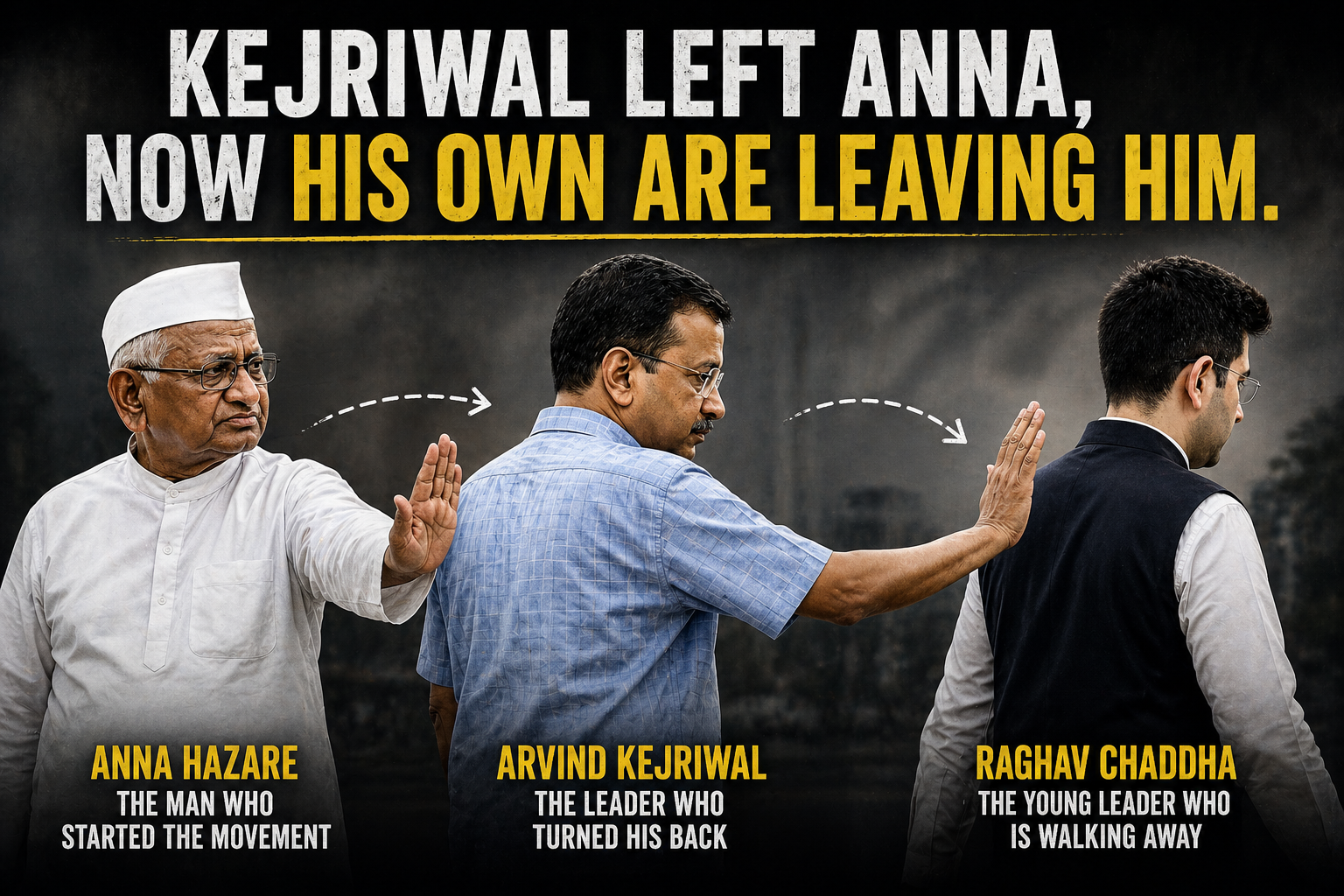
Arvind Kejriwal, who once parted ways with Anna Hazare to form his own political party, is now witnessing a similar exodus within his ranks. Just days ago, seven of AAP’s ten Rajya Sabha MPs – Raghav Chadha, Swati Maliwal, Harbhajan Singh, Sandeep Pathak, Ashok Mittal, Rajinder Gupta, and Vikram Sahney resigned from the party and announced their merger with the BJP.
There was a time when Kejriwal stood with Anna Hazare during the anti-corruption movement. People were on the streets, angry with the system, and hoping for change. Kejriwal was not seen as a typical politician then. He was someone challenging the system. He spoke about ending VIP culture, reducing privileges of leaders, and putting the common man first.
People believed him. They voted for him. And that belief gave him power.
That is where things slowly started changing.
After coming to power, decisions and actions began to look different from what people had expected. One of the early talking points was about benefits and security for politicians. The same system that was supposed to reduce political privilege now seemed to be adjusting itself again. The common man was left wondering whether anything had really changed.
Then came the controversy around the Chief Minister’s residence, often called “Sheeshmahal” by critics. The leader who once talked about simplicity was now being questioned for living in what opponents described as a lavish setup. Supporters defended it, but the perception had already started shifting.
This is where trust begins to get affected.
Inside the party as well, things were not always smooth. Kumar Vishwas, who was once a key face of the movement, had already distanced himself earlier. At that time, it looked like a small internal issue. Now it feels like it was just the beginning.
Now the focus has shifted to Raghav Chadha. He has been one of the most visible young leaders of the party. Educated, confident, strong in debates, and very active on social media, he connected well with urban youth. For many young voters, he represented the modern face of AAP. That is why any talk of him stepping away or distancing himself creates a bigger impact.
Swati Maliwal, a well-known women’s rights activist and former Chairperson of the Delhi Commission for Women, has been one of the sharpest critics of the party. She cited growing corruption, harassment of women, and promotion of goons as key reasons for her exit. Maliwal had a serious public fallout with the AAP leadership after an alleged assault incident at Kejriwal’s residence in 2024.
Harbhajan Singh, the popular former Indian cricketer famously known as the ‘Turbanator’, also chose to end his association with AAP. Nominated to the Rajya Sabha in 2022, he kept a relatively low profile in active politics during his time with the party before making this shift.This group of seven MPs represents more than two-thirds of AAP’s strength in the Rajya Sabha, allowing them to merge with the BJP without losing their seats under the anti-defection law. The exit of such prominent faces has added fresh questions about the party’s direction and internal unity.
And it is not just about one or two persons. Over time, several leaders have moved away from the party or chosen different political paths. This is making people think that the issue might be bigger than just individual decisions. This is where the past comes back into the conversation. When Kejriwal left Anna Hazare and entered politics, it was seen as a bold move for change. Today, when leaders begin to leave Kejriwal, people are looking at it differently. That is why one line is trending everywhere:
Kejriwal left Anna, now his own are leaving him.
It sounds simple, but it connects two different moments very clearly.
He once questioned the system. Now he is being questioned. He once spoke against political privilege. Now he is being judged on it. He once promised change. Now people are asking what actually changed.
For the common man, this is confusing. The same person who spoke for them now seems distant from that image.
Of course, politics is never that simple. Leaders leave for many reasons. There are internal differences, personal ambitions, and strategic decisions. But perception matters, and right now the perception is not in Kejriwal’s favor. This is not just another political phase. This is a test.
It is no longer about how he came to power. It is about whether he can hold his team together. It is about whether he still stands by what he once promised.
Because in the end, one thing becomes very clear. You can move forward and leave your past behind. But in politics, your past has a habit of coming back and standing right in front of you.